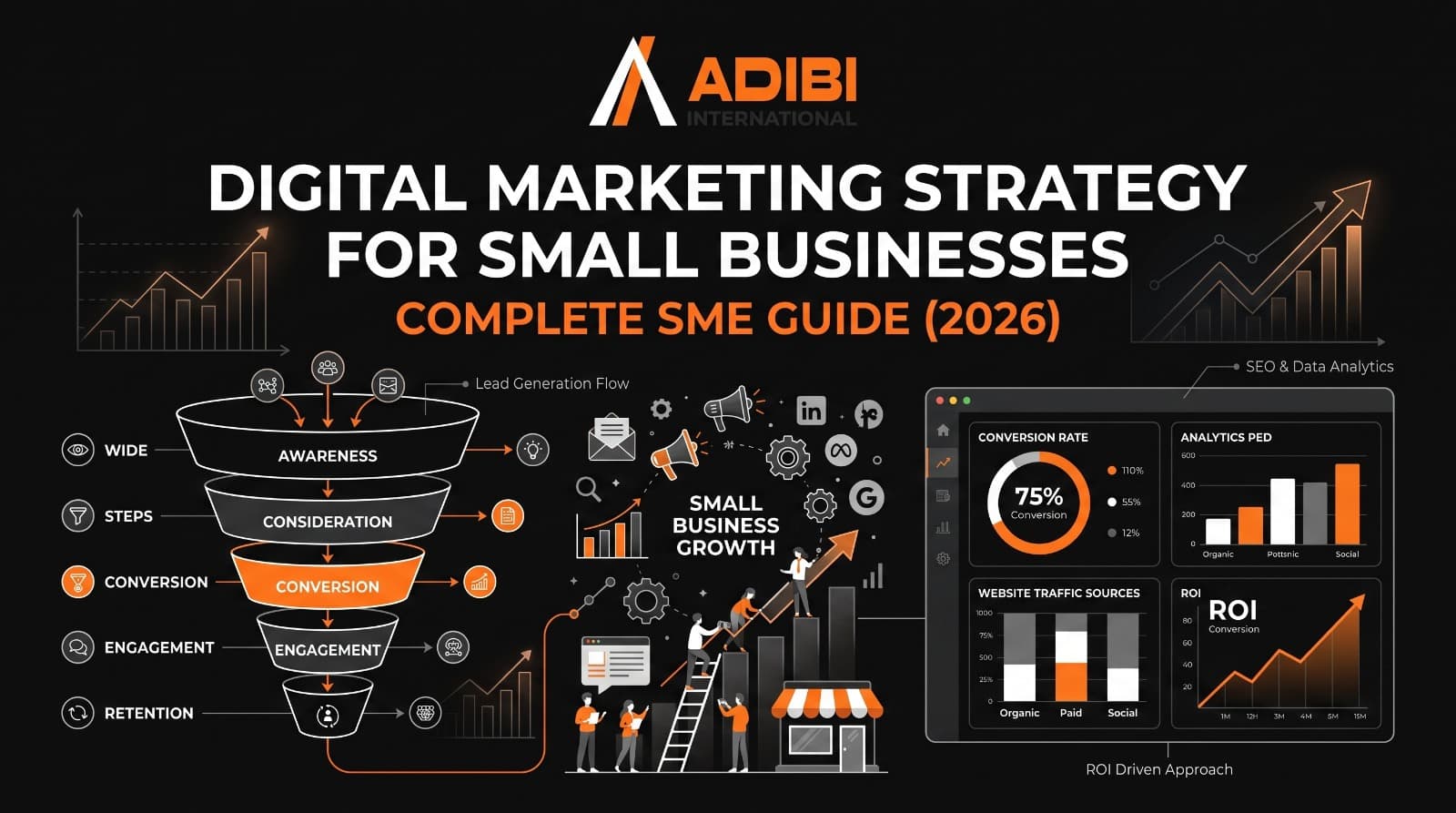
If you run a small business, you've probably felt this tension: everyone tells you that you need a digital marketing strategy, but nobody explains what that actually means once you strip away the buzzwords. You don't need a 40-page marketing plan. You need a clear, workable digital marketing strategy for small business growth that fits your budget, your team size, and your customers.
That's what this guide is for. No fluff, no theory for theory's sake, just a practical SME marketing strategy you can start applying this week.

What Is a Digital Marketing Strategy (And Why Small Businesses Get It Wrong)
A digital marketing strategy is a documented plan outlining how your business will attract, convert, and retain customers through online channels, including your website, search engines, social media, email, and paid advertisements. It's different from a marketing tactic. Posting on Instagram is a tactic. Deciding why you're on Instagram, who you're trying to reach there, and what success looks like is a strategy.
Most small businesses skip the strategy step entirely. They jump straight to tactics: boosting a Facebook post, running a Google ad, sending the occasional email newsletter. The result is usually inconsistent results and wasted budget, because there's no underlying plan connecting the dots.
A good online marketing plan for SMEs answers four questions before a single ad is created:
1. Who exactly are we trying to reach?
2. Where do those people spend their time online?
3. What do we want them to do (buy, book, subscribe, call)?
4. How will we know if it's working?
Step 1: Define Your Target Customer, Not Just Your Market
"Small business owners" or "homeowners" is not a target audience; it's a category. A real target customer profile includes income level, location, buying triggers, and the specific problem your product or service solves for them.
Spend an afternoon writing down your three best customers from the last year. What did they have in common? Why did they choose you over a competitor? This single exercise typically reveals more useful marketing direction than any generic buyer persona template.
Step 2: Set Goals That Actually Mean Something
Vague goals like "get more traffic" or "grow our social media" don't give you anything to measure against. Instead, tie every marketing goal to a business outcome:
- Increase qualified leads by 20% in 90 days
- Reduce cost per acquisition by 15%
- Grow email list to 2,000 subscribers by year-end
- Convert 10% of website visitors into a booked call
These goals should map directly to revenue, not vanity metrics like follower counts.
Step 3: Choose the Right Channels, Not All of Them
One of the most common mistakes SMEs make is trying to be everywhere at once. A five-person business does not need to be active on six social platforms, a blog, a podcast, and paid search simultaneously. Pick two or three channels where your specific customers actually spend time, and go deep rather than wide.

Search Engine Optimization (SEO)
SEO remains one of the highest-ROI channels for small businesses because it targets people who are already searching for what you offer. A well-optimized website, local business listings, and consistent content around customer questions can generate compounding traffic over time, traffic you don't have to pay for on an ongoing basis.
Paid Advertising (PPC and Meta Ads)

Pay-per-click and Meta advertising (Facebook and Instagram) are faster than SEO but require an ongoing budget. They work best when you already have a converting website and a clear offer, because paid traffic exposes weak conversion points quickly. Platforms like Google and Meta both publish detailed advertising guidance worth reviewing before you set your first budget.
Social Media Marketing

Social platforms are less about direct sales and more about trust-building and visibility. For most small businesses, organic social content supports the buying decision rather than triggering it directly. If you want a partner to handle the day-to-day strategy, content, and ad management for this channel, Adibi International's social media marketing services (https://adibi.co.uk/services/social-media-marketing) are built specifically around SME budgets and goals.
Email Marketing

Email is frequently underused by small businesses, yet it consistently produces strong returns because you own the list; no algorithm decides who sees your message. A simple monthly newsletter combined with automated welcome and follow-up sequences can quietly become one of your most reliable revenue channels.
Step 4: Build a Website That Actually Converts
Traffic without conversion is wasted marketing spend. Before increasing your ad budget or content output, audit your website for:
- Clear, specific headlines that state what you do and for whom
- Fast load times, especially on mobile
- Obvious next steps (call, book, buy) above the fold
- Trust signals: reviews, case studies, certifications
Resources like HubSpot and Search Engine Journal regularly publish research on conversion rate benchmarks by industry, which is a useful sanity check for whether your website is underperforming.
Step 5: Create a Realistic Content Plan
You don't need daily content across every platform. You need consistent, useful content that answers real questions your customers are asking. A practical starting cadence for most small businesses:
- 1–2 blog posts per month targeting specific customer questions
- 3–4 social posts per week on your primary platform
- 1 email per month, minimum
Consistency beats volume. A business that publishes reliably once a week for a year will usually outperform one that posts daily for a month and then goes quiet.
Step 6: Track the Numbers That Matter
You can't improve what you don't measure. At minimum, track:
- Website traffic and traffic source
- Conversion rate by channel
- Cost per lead and cost per acquisition
- Customer lifetime value
Tools like Google Analytics and Search Console are free and sufficient for most small businesses starting out. Paid tools such as Ahrefs or Semrush become useful once you're investing seriously in SEO and want deeper keyword and competitor data.
Building the Strategy Around Your Budget
Budget determines pace, not possibility. A small business spending £500 a month can still build a sound digital marketing strategy; it simply needs to prioritize one or two channels deeply rather than spreading thin. As the budget grows, you add channels rather than starting over.
According to Adeel Talat, founder of Adibi International, the biggest budgeting mistake he sees among small business owners is treating marketing as a one-off expense rather than an ongoing investment. "The businesses that grow steadily are the ones that commit to a channel for at least three to six months before judging whether it's working," he notes. "Most SMEs give up right before a strategy starts to compound."
Common Mistakes SMEs Make in Digital Marketing

- Switching strategies too often. Every channel has a ramp-up period. Abandoning SEO after six weeks or ads after three days rarely gives either enough time to show real results.
- Ignoring existing customers. Retention marketing (email, loyalty offers, remarketing) is usually cheaper than acquiring new customers, yet it's often the first thing cut from the budget.
- No clear offer. Traffic and ads can't fix a vague or uncompetitive offer. Strategy comes after the offer is right, not instead of it.
- Not tracking ROI by channel. Without channel-level data, it's impossible to know where to double down or pull back.
Do You Need an Agency or Can You DIY It?

Many small businesses start by managing marketing in-house, which makes sense when budgets are tight and the owner has time to learn the basics. The tipping point for bringing in outside help usually comes when:
- Marketing tasks are consistently pushed aside for day-to-day operations
- You've tried a channel without success and aren't sure why
- You're ready to scale but lack the internal expertise to manage paid campaigns properly
At Adibi International, Adeel Talat and the team work with small businesses across the UK, US, and Europe on Meta Ads, PPC, SEO, web development, and ecommerce marketing, building strategies sized to each business's actual budget rather than a one-size-fits-all package.