If you've got a limited marketing budget and you're trying to decide between Google Ads and Facebook Ads, you're not alone. It's one of the most common questions small business owners ask before spending their first pound or dollar on paid advertising.
The honest answer is that Google Ads and Facebook Ads solve different problems. Google Ads captures people who are already searching for what you sell. Facebook Ads (now part of Meta's advertising platform, which also covers Instagram) puts your business in front of people who aren't searching yet, but who match the profile of someone who would buy.
Neither platform is universally "better." The right choice depends on your product, your sales cycle, your budget, and how aware your audience already is of the problem you solve. This guide breaks down exactly how each platform works, where each one wins, and how to decide without the generic "it depends" non-answer you'll find elsewhere.
What's the Core Difference Between Google Ads and Facebook Ads?
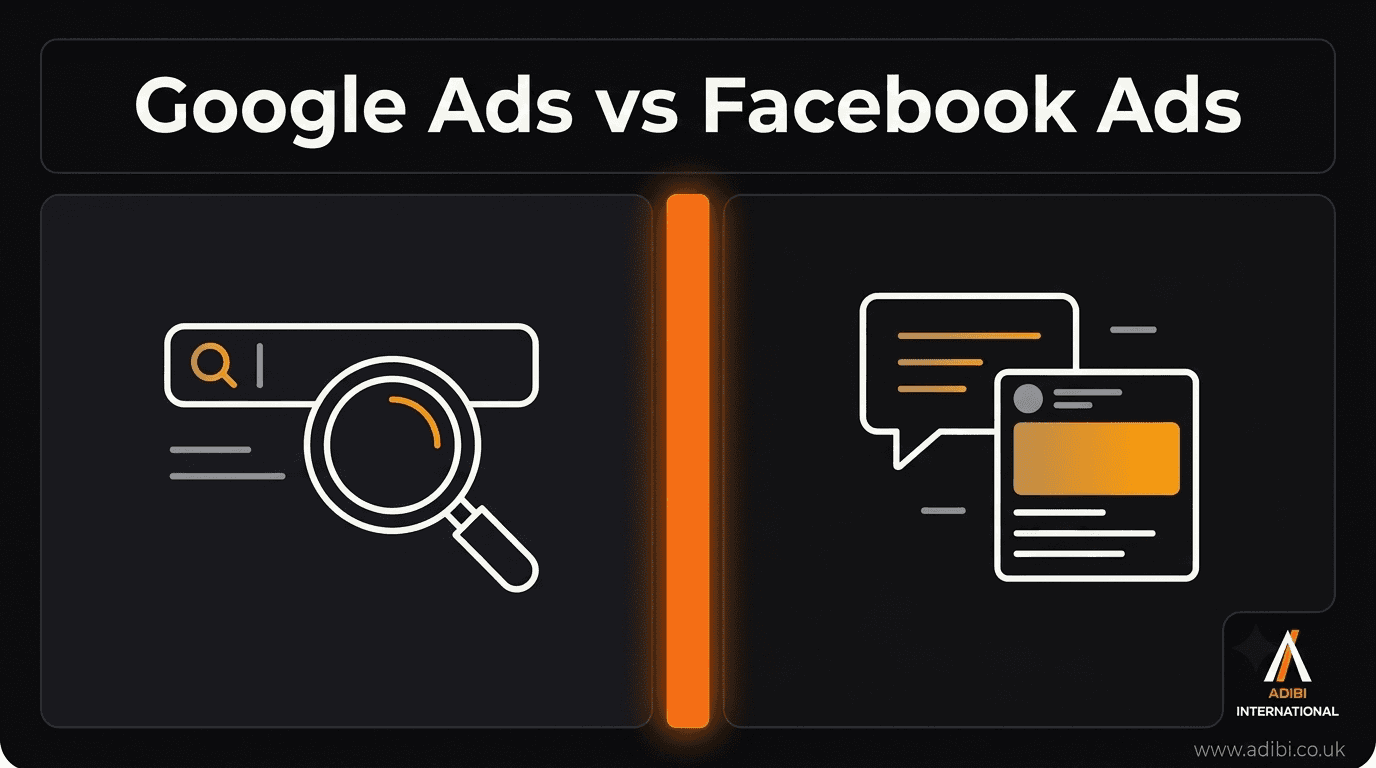
The simplest way to understand the difference is intent versus interruption.
Google Ads is intent-based. Someone types "emergency plumber near me" or "best CRM for small teams" into Google. They already have a need. Your ad shows up at the exact moment they're looking for a solution.
Facebook Ads are interruption-based. Someone is scrolling their feed, not actively shopping. Your ad has to stop the scroll and create interest in something they weren't necessarily thinking about a second ago.
This distinction shapes everything else: the cost structure, the creative you need, the buying stage you're targeting, and the kind of business that benefits most from each platform.
Google Ads: Built for Demand Capture
Google Ads (formerly Google AdWords) is a pay-per-click system that places your business at the top of search results, on the Google Display Network, on YouTube, and within Google Shopping listings. Search campaigns are the most common starting point for small businesses because they target keywords people are actively typing into Google.
According to Google's own advertising resources, search ads work because they match supply (your business) with existing demand (the search query), which is why they tend to convert well even on a modest budget, provided the keywords and landing page are aligned.
Facebook Ads: Built for Demand Generation
Facebook Ads (run through Meta's Ads Manager, which also serves Instagram, Messenger, and the Audience Network) work on a different principle: audience targeting based on demographics, interests, behaviours, and lookalike profiles built from your existing customers.
Meta's own Business Help Center explains that campaigns are typically structured around objectives like awareness, traffic, leads, or sales, with the algorithm optimising delivery toward people most likely to take that action, even if they've never heard of your brand before seeing the ad.
Google Ads vs Facebook Ads: Side-by-Side Comparison

This table is a starting point, not a rulebook. A B2B software company might run Google Ads to capture "best invoicing software for freelancers" while also running Facebook Ads to build awareness with case studies and testimonials before that search even happens.
When Google Ads Tends to Win
1. Your product or service has clear, searchable demand. If people actively type queries related to what you offer, "boiler repair Manchester," "divorce solicitor London," "accounting software for small business," Google Ads puts you in front of buyers at the exact decision point.
2. You operate in a local service business. Plumbers, dentists, locksmiths, contractors, and similar local services consistently perform well with Google Search and Local Service Ads because the searcher already wants to hire someone now.
3. You need fast, measurable ROI on a defined offer. Google's auction system means you can often see cost-per-click and conversion data within days, letting you adjust quickly without guessing.
4. Your sales cycle is short. E-commerce stores, repair services, and single-purchase products tend to do well because there's minimal nurturing required between click and sale.
When Facebook Ads Tend to Win
1. Your product benefits from visual storytelling. Fashion, home goods, fitness products, food and beverage, and lifestyle brands perform well on Meta's platforms because the format rewards strong imagery and video.
2. You're building a new brand with no existing search demand. If nobody is searching for your specific product yet, a new app, a niche subscription box, or an unfamiliar service, Facebook and Instagram let you create that demand by reaching the right audience profile directly.
3. You want to retarget warm traffic. Facebook's retargeting (showing ads to people who already visited your site or engaged with your content) is highly effective for nudging undecided visitors back toward a purchase.
4. You have a longer or more considered purchase. Higher-ticket items, courses, and B2B offers often need several touchpoints before conversion. Facebook Ads can nurture that journey through a sequence of awareness, consideration, and conversion campaigns.
Cost Comparison: Which Platform Is Cheaper?
There's no fixed answer here; costs vary heavily by industry, competition, and the quality of your campaign setup. As a general pattern:
Google Ads costs are driven by keyword competition. Highly competitive terms in law, finance, and insurance can carry a high cost-per-click, while niche or local terms are often more affordable.
Facebook Ads costs are driven by audience size, creative quality, and ad fatigue. Costs can start lower but rise quickly if your creative isn't refreshed or your audience is too narrow.
Industry benchmark data from sources like WordStream's PPC and social ad benchmarks is useful for setting expectations, but treat any published average as a rough guide; your actual numbers will depend on your specific market and how well your account is structured.
Can You Run Both? (Usually, Yes)
Most small businesses that scale past their first few months of advertising end up running both platforms, not because more spend is automatically better, but because the two channels do different jobs well.
A common, effective structure looks like this:
Facebook/Instagram Ads build awareness and warm up an audience with content, offers, and social proof.
Google Search Ads capture the people who, having seen your brand or independently searched, are now ready to act.
Retargeting on both platforms brings back visitors who didn't convert the first time.
This is why agencies typically recommend testing both with a modest budget split before committing fully to one. At Adibi International, founder Adeel Talat often advises small business clients to start with whichever platform matches their current buyer awareness search if customers already know what they need, Meta if the brand still needs to introduce itself, rather than picking a platform based on what's trending.
How to Decide: A Practical Checklist
Ask yourself these questions before allocating budget:
Do people search for what I sell? If yes, lean toward Google Ads.
Is my offer visually compelling or aspirational? If yes, lean toward Facebook/Instagram.
What's my sales cycle length? Short cycles favour Google; longer nurture cycles favour Meta.
Do I have creative assets (photos, video) ready? Facebook Ads demand more creative investment than search ads.
What's my monthly budget? Under roughly £500–£1,000/month, focus on one platform and do it well rather than splitting thin across both.
A Note on Setting Up Either Platform Properly
Regardless of which platform you choose, the businesses that get the best results share three things in common: clean conversion tracking, a tested landing page, and a funnel structure that separates cold audiences from warm ones rather than throwing everyone into a single campaign.
This is where a lot of small business accounts lose money, not because the platform doesn't work, but because the account structure does. If you're considering Facebook and Meta advertising for your business, the audit-first approach (reviewing what's already happening in an account before spending more) tends to surface the biggest, cheapest wins before a single extra pound is spent on new campaigns. The same audit-first principle applies on the Google PPC and Search Ads side, where wasted spend often comes down to overly broad keywords or a mismatched landing page.
Adeel Talat, founder of Adibi International, built the agency's approach around this audit-first philosophy after seeing how many small business accounts were paying for clicks that never had a real chance of converting.
Ready to Stop Guessing Which Platform Works for You?
If you're still unsure whether Google Ads, Facebook Ads, or a combination of both is right for your business, the fastest way to find out isn't more research; it's a clear look at your numbers, your audience, and your sales cycle.
Adibi International offers a free account audit for businesses considering Meta advertising, so you can see exactly where budget might be leaking before you commit to a bigger spend. Get in touch to talk through which platform fits where your business actually is right now.